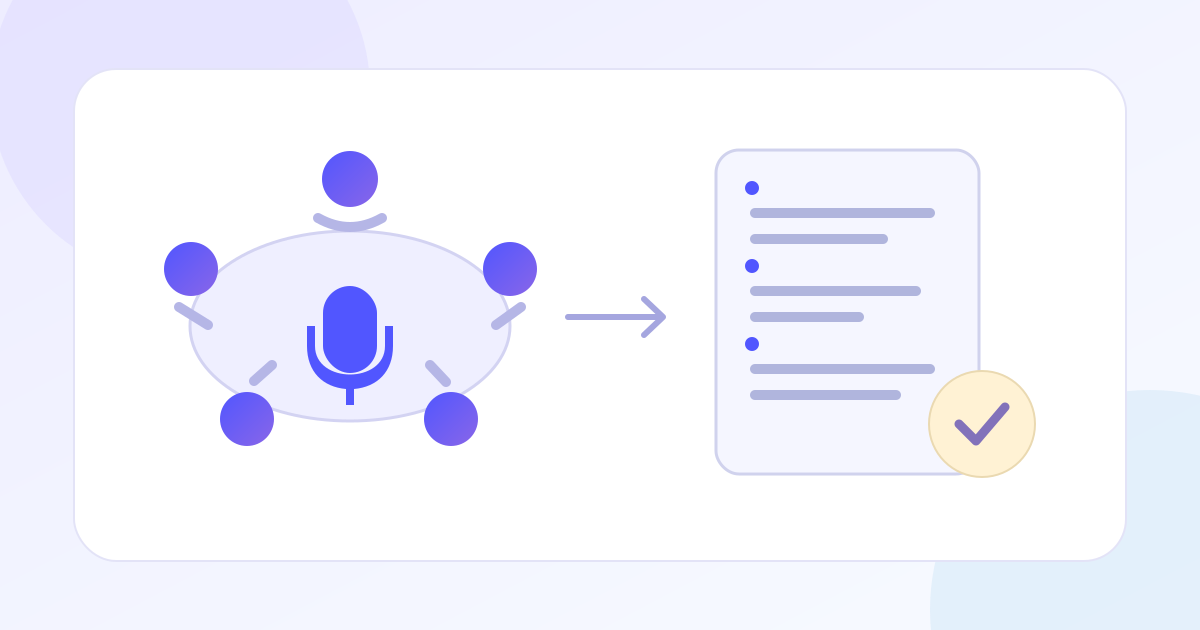
To transcribe a focus group, keep the saved recording and a clear transcription convention, produce a draft, then replay the audio to check every relevant speaker turn. Preserve uncertain words, overlapping speech, negatives and conditions. The goal is a discussion record you can trace to its source, without quietly merging several people into one confident paragraph.
Go to the saved-recording transcription steps
Decide what the transcript must preserve
- For content or thematic review, agree which fillers can be omitted while preserving each contribution, question, negative and condition. Do not rewrite a participant’s wording into a stronger claim.
- For interaction analysis, retain the interruptions, pauses, laughter and short responses your method requires. Automatic punctuation and speaker turns do not establish those details.
- For a few quotations, keep a source-linked excerpt and mark the rest of the session unreviewed. A handful of checked quotes is different from a complete transcript.
Write the convention at the top of your working document before editing. Keep the original draft and a change record. A transcript, your interpretation of it, and a findings summary serve different purposes; separate them so a later reader can see which words came from the group.
Define the convention in your document; these names are not universal rules. Here is the same author-written utterance in two conventions. Neither version is an observed tool result.
- Author-written source: “Um, I—I li— I liked the, the reminders [pause], but not every day [laughs].”
- Lightly edited for this example: “I liked the reminders, but not every day.” For this content-focused example, omit the filler, repeated syllables and words, abandoned word start, and incidental pause/laughter markers; preserve the complete contribution, negation and condition. If timing, hesitation or laughter matters to your method, retain it instead.
- Detailed verbatim for this example: “Um, I—I li— I liked the, the reminders [pause], but not every day [laughs].” For this example, retain the audible filler, repetition, unfinished word, pause and laughter, without assigning a feeling or measuring an unmeasured pause. More detailed interaction analysis may need a specialist convention.
- The light version must not become “I liked daily reminders.” Preserve the source draft and record the chosen editing rule. An omitted event under a declared convention is not proof the event did not occur.
Use a consistent notation key
A small working key for this guide; adapt and document it before transcription. Square brackets contain editorial event or uncertainty markers, not automatically verified words.
- [unclear word] / [inaudible] — A word cannot be established / the passage cannot be heard clearly enough to transcribe. Add the source-relative time; keep any candidate word in a review note, outside the quotation.
- speaker unresolved — The contributor is not established for this turn; intelligible words may still be recorded. A neighbouring label, seat or louder voice is not proof.
- [overlap A: words] — Matching A markers on separate lines identify the portions that are simultaneous in the illustration. A is a local overlap reference, not a participant code. Mark only the extent you can establish by listening; if words or boundaries are unclear, write [overlapping speech] with a time reference rather than filling them in.
- [pause] — An audible pause, with no duration asserted. Add a measured duration only if you actually establish it and your method requires it.
- [laughs] — Audible laughter, without claiming embarrassment, agreement or another inferred emotion. Leave its attribution unresolved if it cannot be established.
- li— / I—I / the, the — An unfinished word / repeated syllable or word, retained where the declared convention requires it. Do not complete an abandoned word from context.
Keep a source record and a separate participant key
- Record the session ID, original filename, duration and relevant recording date. Keep a protected master copy and work from a copy you are allowed to process.
- Use stable codes such as M for moderator and P1, P2 for participants. If several sessions use P1, add the group ID. Keep any real-name key separately with appropriate access controls.
- Use introductions, an authorized seating note or a permitted video reference to investigate who spoke. A participant list or seat alone does not prove the source of every turn. People move, speak softly or share a microphone.
- If you have multiple tracks or excerpts, keep their file identities and start offsets. Do not assume timestamps or automatic Speaker 1 labels correspond across separate uploads.
A code is not a guarantee of anonymity. Names spoken in the discussion, employers, distinctive experiences and other details can still identify someone. Keep replacements consistent in a separate sharing copy and log what changed. The UK Data Service’s guidance explains why removing names alone is insufficient and why both over-removal and under-removal can damage a dataset. Its advice on protecting data is not an approval to upload research audio to an external service; resolve the project’s processing conditions separately.
UK Data Service guidance on anonymising text
Before sending any recording to a network service, confirm that recording, transcription, external processing and the intended sharing fit your project’s permissions and institutional requirements. Other participants have heard the discussion, so do not promise that group confidentiality is guaranteed. UConn’s focus-group guidance addresses these issues in its own research setting; your institution or project may have different requirements. This demo does not make a research protocol or data-sharing decision for you. Replacing names in a transcript does not remove spoken identifiers from the audio you upload; check the original recording and the project’s external-processing permissions separately before sending it to a service.
Check the preview window before upload
The current embedded audio component has a five-minute per-request ceiling, but the initial demo file allowance is 120 seconds shared across audio and video uploads. Processing uses the shortest of the file duration, actual remaining time and that ceiling. Previous usage can leave less time. Check Free time left (audio) in the confirmation before proceeding. The service rechecks remaining time; a stale or unavailable quota reading is not a promise of a fresh two minutes. This is a draft preview rather than an unlimited full-session service. Splitting a recording does not reset shared demo time.
Failures that stop before transcription and its summary finish do not reach this demo’s time debit. A short, inaccurate or partially useful successful transcript can still consume time. If a response is lost or an error occurs after the debit, the allowance may already have changed. Check the current balance before retrying; an error on screen does not promise that the attempt used no time.
Transcribe a saved focus-group recording with JotMe
Use the clearest supported audio copy you have. MP3, WAV and M4A are common choices, but the actual codec and readable duration matter. A meeting link, participant list or image of notes is not an audio file. Export the recording through the original service if needed; do not rename a file extension to convert it. For a supported saved video, use the separate video-to-text page.
- Open and play the saved recording locally. Check the start, ending and a few quiet or overlapping passages so you know what the source actually contains. Keep the original filename and any excerpt offset.
- Select or drop the supported audio into the demo and allow it to read the duration. If it cannot read the file, obtain a supported export or genuine conversion; repeatedly submitting the same unreadable file will not fix it.
- Choose Transcribe. In Review before starting, inspect File, Duration and Free time left (audio), then choose Proceed to transcribe. Selection prepares the file; confirmation starts processing. Only send content you are allowed to process externally.
- Read the visible timestamped segments in the spoken language. Source language is detected automatically; there is no manual source-language selector here. The displayed minute-and-second ranges are draft file-relative references, not measured talk-time evidence; a plain-text fallback can have 00:00–00:00. Keep any excerpt’s original offset and check speaker labels and punctuation against the source.
- Replay the matching passage in your own player. Check the words, negatives, turn boundaries and who can actually be established as speaking. Mark uncertainty and missing coverage rather than filling gaps from the discussion topic.
- Save the visible text into a separate working document with its source reference and review status before choosing another file, starting another transcription, Transcribe again or leaving. The result is local page state; selecting another file can clear it even if that file is invalid. There is no inline editor, Copy all control or transcript download here. If browser text selection works, paste and inspect it; otherwise record a short passage manually.
Try it yourself
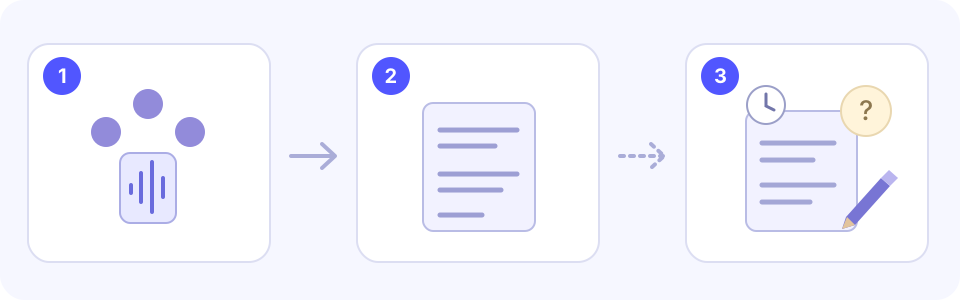
Move from the sample to the full recording
- Save and inspect the sample in a separate document first. Transcribe again opens the same audio-to-text demo with the same shared allowance; it does not continue from an offset or unlock more free time. A preview notice does not prove that a hidden remainder was transcribed or saved.
- For a longer eligible recording, use the embedded Sign up link to the JotMe web app. Sign in or create the account and complete verification/onboarding as needed, then choose Transcribe file in the workspace. Select the original supported local recording anew, review the duration, language and current account minutes/plan limits, and confirm the new upload. Neither the file, saved corrections nor an already processed remainder transfers automatically. No particular signup allowance or unlimited duration is promised.
- Keep the original recording and review successive sections against it, including the ending. Record the ranges checked and leave the rest unreviewed. For separately prepared excerpts, keep the original filename and start offset, add that offset to draft-relative times, and recheck speaker attribution for each request. Separate uploads are not automatically stitched into a common participant key; preparing excerpts does not reset the demo balance.
Open the audio transcription page after saving the current text
Verify speakers turn by turn
Start with a passage whose speaker you can establish from the authorized source, then check later turns individually. The same person can be split into several automatic labels, and a label can wrongly combine people. Renaming every Speaker 1 to P1 because of one correct introduction can spread an error across the document. Keep a turn unresolved when the evidence does not settle it.
- Moderator: separate the question or prompt from the participant’s answer. Do not count a prompt as a participant view.
- Short responses: check “yes,” “no” and “same here” in context. A nearby louder voice is not proof of who said a quiet reply.
- Overlapping speech: mark [overlapping speech] with a time reference. Attribute separate contributions only when you can actually hear and establish them. Do not turn two partial sentences into a single confident quote.
- Unclear words: mark [inaudible] or [unclear word] at the relevant passage. Keep a candidate interpretation as a note, not as an established quotation.
- Changed voice or position: recheck attribution after a break, microphone change or movement. Do not infer someone’s identity or characteristics from an automatic speaker number.
Fictional before-and-after in a separate working document. These draft labels are invented and do not report an actual JotMe output. Correct the turn, not every occurrence of a label.
- 00:10 | Before: M, previously checked: “How did the reminders work for you?” | After: M, unchanged: “How did the reminders work for you?” | Evidence: Keep the previously checked moderator prompt separate from participant responses; the later correction supplies no new evidence about this turn.
- 00:24 | Before: Speaker 1: “I liked the reminders, but not every day.” | After: P2, attribution checked for this turn only: “I liked the reminders, but not every day.” | Evidence: In the fictional review, a permitted, contemporaneous video reference is checked at this exact turn alongside the matching audio; P2’s established code is supported for this turn. A seating plan or an introduction elsewhere alone would not settle it.
- 00:27 | Before: Speaker 1: “Not for me.” | After: speaker unresolved, overlapping: “Not for me.” | Evidence: The quiet contributor’s words are distinguishable in this illustration, but the permitted evidence does not establish the speaker. Do not propagate the 00:24 correction to this turn.
- The overlap example supplies the simultaneous word spans; these correction rows isolate the attribution change. Keep the original draft. Automatic labels across different files/requests are not a shared participant key. A checked code is not proof of anonymity or permission to share.
A fictional example: preserve disagreement and uncertainty
Author-written illustration only: the words, times and review decisions below are fictional, not an uploaded recording or a JotMe result. Times are illustrative source-relative references, not measured talk-time evidence. Matching overlap A markers show the simultaneous portions.
- [00:10] M, attribution checked: “How did the reminders work for you?”
- [00:24] P2, attribution checked: “I liked the reminders, but [overlap A: not every day].”
- [00:27] speaker unresolved: “[overlap A: Not for me].”
- Review note: In this illustration, P2’s words and the separate negative response are distinguishable; the quieter contributor’s identity remains unresolved. Replay the corresponding source before making the same decisions in a real transcript. Do not change that turn to P3 because P3 appears next in a draft. If the simultaneous words cannot actually be heard, retain [overlapping speech] instead of this invented wording.
- Analysis note: The moderator’s question supplies context and is not a participant opinion. The excerpt contains one conditional positive response and a separate disagreement; “Not for me” answers this prompt and does not establish a broader dislike of reminders. It does not show group consensus. The rest of the session is unreviewed.
Record corrections and coverage
- Header: session ID, source file, duration, excerpt offset, spoken language, transcription convention, draft date and review date.
- For each turn: source-relative time, stable speaker code or unresolved label, wording and explicit uncertainty markers. Keep the original draft available for comparison.
- Correction record: what changed, who reviewed it and the source or permitted reference supporting the change. Keep a spelling correction separate from an inferred intention.
- Coverage: identify sections checked against the audio and sections not transcribed or not reviewed. An omitted passage is not evidence that nobody spoke.
- Sharing copy: remove or replace identifying details as the project requires, using consistent codes and a separate change log. Review context as well as names; code replacement alone does not make data anonymous.
Completed fictional log row, for the 00:24 turn only; Example reviewer A is an invented reviewer. This records attribution evidence, not an inferred intention or a claim about the entire file.
- Source / time: FG-example / session-example.wav / original-source 00:24; excerpt offset 00:00 (all fictional)
- Draft wording or label: Speaker 1: “I liked the reminders, but not every day.”
- Correction: This turn only → P2. Keep the wording and its condition; preserve the overlap A marker in the working transcript.
- Supporting evidence: Fictional replay of the matching original audio plus a permitted video reference for this exact turn supports P2. The 00:27 overlapping contributor remains unresolved; this decision does not rename later Speaker 1 turns.
- Reviewer: Example reviewer A / example review date 2026-10-21
- Status: Attribution checked for 00:24 only; wording checked for this example passage. Rest of session unreviewed; 00:27 identity unresolved.
- Keep spelling or wording corrections separate from interpretation. Keep a distinct anonymisation/sharing-copy log for identifier replacements; neither log changes the source recording.
Keep simultaneous turns in separate lines when they are distinguishable. Do not add segment durations together to claim each participant’s exact talk time: boundaries, overlap, missing speech and attribution can all be wrong. This embedded demo has no verified research-coding export, participant roster manager or talk-time report. Move only the text you have actually saved into your own analysis workflow.
When a group recording is difficult to understand
- Quiet or distant speech: return to the clearest original or authorized backup. Re-encoding does not restore words that were never audible.
- Several tracks: inspect each with its source reference and offset. More files require more review, and automatic labels from separate requests are not one shared participant key.
- Mixed languages: have an appropriate fluent reviewer check the original. Automatic language detection is not a guarantee, and a translated sentence cannot repair a misheard word.
- A missing ending: check the original duration and remaining window. Keep uncovered passages marked; do not assume a signup prompt means hidden text has already been saved.
- Unresolved overlap or consequential quotes: preserve the gap and obtain suitable human review before using the passage. A natural-sounding draft is insufficient evidence for a quotation or participant attribution.
Keep translation and findings separate from the transcript
For a translation that keeps your manual corrections as its starting point, save and check the original-language transcript in your own document first. Open text translation, choose the available source and supported target language, and paste a checked passage. It translates submitted text after a short pause and has its own current limits. Keep speaker codes, time references, the source wording and the translated version separately, then have the translation checked. A translation is not a verbatim quotation in the original language.
Translate a checked transcript passage as text
Alternatively, the audio-translation workflow needs a new audio selection and generates its own transcription before translating the returned segments. It does not import corrections you made in a separate document. Check that independently generated wording and attribution against the source again; if some segment translations fail, original-language text can remain after transcription time has already been used. A summary or fluent translation cannot repair a misheard word, invent group consensus or establish a speaker’s identity.
Translate saved audio into a supported reading language
For a one-to-one interview, use the interview guide’s quote and speaker checks. For a single-presenter lecture, the lecture guide covers notes and terminology. A focus group adds a distinct task: retain interactions between people without inventing consensus or forcing uncertain turns into known identities.
Check an interview transcript and its quotations
Review a lecture recording and its terminology
UConn’s focus-group research guidance
Read JotMe’s actual privacy terms before external processing
Frequently asked questions
How do I transcribe a focus group recording?
Keep the saved recording and a source reference, choose a transcription convention, generate a draft and replay the relevant speaker turns. Verify wording, negatives, overlap and attribution, then save a separate checked working copy. The embedded JotMe tool provides a limited original-language preview, not a complete participant-identified research transcript.
Can JotMe automatically identify every participant?
No. The demo displays automatic speaker-labelled segments, but labels are not verified identities. One participant can receive multiple labels or several people can be merged. Use authorized source evidence to check individual turns and keep unresolved attribution marked. Do not globally rename a label based on one correct passage.
How should I write overlapping or unclear speech?
Mark the passage explicitly, for example [overlapping speech] or [unclear word], with a time reference. Put distinguishable speakers on separate lines only when you can establish their wording and attribution. Keep a possible interpretation in a review note; do not convert a guess into a confident quote.
Can I transcribe a full focus group for free in this demo?
Do not assume a whole group session is free here. The request ceiling is five minutes, while the initial lifetime demo file allowance is 120 seconds shared across audio and video. The shortest of file duration, actual remaining time and request ceiling applies. Check confirmation and visible coverage; older usage can leave less time, and splitting does not reset it. Transcribe again opens the same limited demo. For a longer recording, the separate authenticated web-app Transcribe file workflow requires a new file selection and current account-limit checks; signup does not process a hidden remainder or transfer this file.
Can I edit, copy all or export the result here?
This embedded component has no inline correction editor, Copy all control or transcript download. If your browser permits selection, copy the visible passage, paste it into a separate document and inspect it; otherwise record a short passage manually. Save before another file selection, a new transcription, Transcribe again or navigation. Result text is local page state and can clear on file selection, including an invalid replacement. The full audio page reopens the same demo; an account workflow is separate and does not automatically save or transfer the current recording or transcript.
Do participant codes make a focus-group transcript anonymous?
No. Names mentioned in conversation, employers, locations and distinctive experiences can still identify someone. Follow the project’s approved sharing process, use consistent replacements in a separate copy and keep an appropriate change log. Protect any real-name key separately and review context as well as explicit names. The demo does not anonymize a transcript or approve a research protocol. Replacing a name in text does not remove it from the original audio; check the recording and external-processing permissions separately before upload.
Can I use a summary or translation instead of checking the source?
No. A summary can omit disagreement or conditions, and translation cannot repair a misheard word or wrong speaker label. Check original-language wording and attribution first. To preserve those edits as input, paste a checked passage into text translation with the appropriate supported languages. Audio translation instead starts from newly selected audio and generates its own transcript, without your manual corrections, so that wording needs another source check. Keep source, translation and analysis separate; an unreviewed preview does not establish the whole group’s view.