
Press release translation should carry the same announcement into another language: who is speaking, what happened or will happen, the dates, numbers, quoted words and release instructions. Natural wording matters, but a polished sentence is wrong if it turns a planned event into a completed one or changes what a spokesperson promised.
This guide uses a short fictional announcement to show how to prepare and check a language draft with JotMe. It does not publish a release, distribute it to journalists, manage an embargo, certify a translation or approve legal, financial or regulatory statements.
- Start with the approved source and identify the audience and actual language direction.
- Translate a permitted short passage while keeping the source visible.
- Check facts and attribution, obtain the responsible owner's approval, then use your normal publication process.
Separate Faithful Translation From a New Local Announcement
A faithful translation preserves the approved news. A market adaptation may change the lead, replace an example or add a local contact, but those are editorial decisions for the communications owner. Keep the faithful version and record separately approved changes. Do not invent local operations, availability, certifications, prices or quotations to make a release sound relevant.
PR Newswire's international guide separates release structure, translation, local context and distribution. Its advice to prepare a glossary and style guide is useful preparation; a translation tool does not independently verify the local facts or carry out the distribution process.
PR Newswire: international press release guidance
Prepare Only Material You Are Allowed to Share
Use the current approved version, with its headline, relevant context and release instructions. Keep a separate reference list for approved brand terms, product names and spokesperson titles. Confirm official local names with the owner instead of translating them by guesswork. A small working brief can say: Audience: UK community media; target: English; style: approved house guide; names: use the approved term list; times: retain UTC. These are review choices you record separately, not separate controls promised by the demo.
Do not enter confidential, embargoed, personal or otherwise restricted material into an external tool unless your organization has approved that use. A label saying “under embargo” is an instruction in the document, not an access-control feature. For practice, use the invented passage below. For a real release, retain the source and any redaction mapping in your approved workspace.
Try a Fictional Spanish Press Release
The following company, event and quote are author-written practice data. This is not a real announcement, an actual spokesperson's statement or a captured JotMe result. The example uses “for immediate release”; no confidential advance news is needed.
Comunicado de prensa. Para difusión inmediata. Ladera Talleres anuncia un taller gratuito de reparación de bicicletas el 20 de noviembre de 2026, de 10:00 a 12:00 UTC, para un máximo de 24 participantes. Las inscripciones cierran el 18 de noviembre de 2026; no se ofrece servicio de reparación durante el evento. «Queremos enseñar mantenimiento básico», dijo Ana Sol, coordinadora del taller. Más información: https://example.org/taller.
- For this exercise, choose Spanish as the source and English as the target. Use your actual source and destination languages for another release.
- Paste the complete labelled practice passage. Translation begins automatically after you pause; there is no separate submit button.
- Keep the Spanish visible and compare each fact before copying the draft into an editable working document.
Check the remaining text allowance first. A new demo displays an initial 5,000-token allowance; previous use can leave less, and tokens do not equal a fixed number of words. Editing the source or changing a language can start another request. Explanation notes can add interpretations, so check them against the approved source rather than treating them as independent facts.
Try it yourself
0 / 5,000 used · 5,000 left
Translation will appear here
Explanation
An explanation of translation choices appears here when your translation is ready.
Check the Announcement Before Improving Its Style
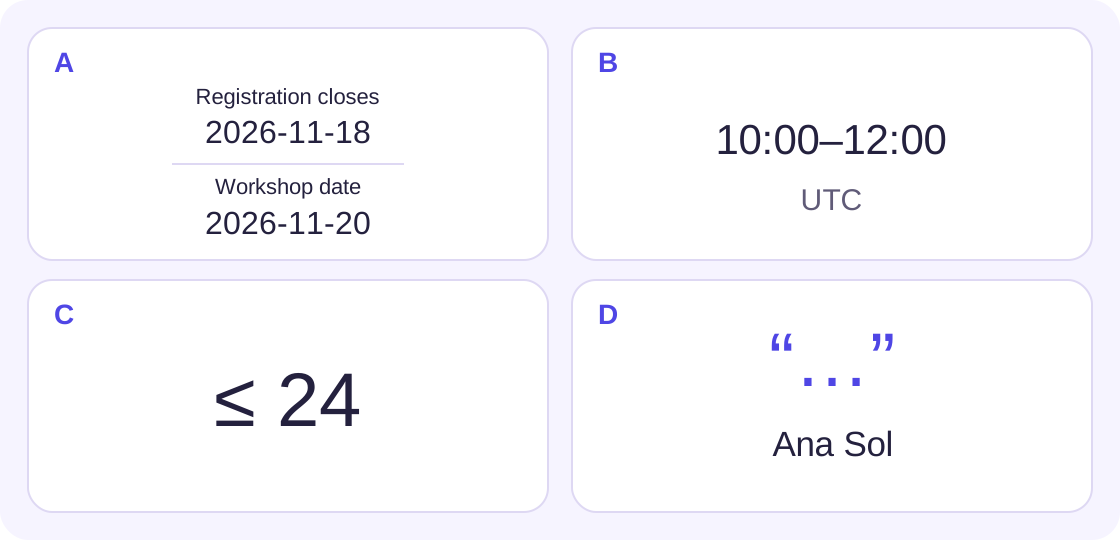
For the fictional passage, a faithful draft still announces a free bicycle-repair workshop on November 20, 2026, from 10:00 to 12:00 UTC, for a maximum of 24 participants. Registration closes on November 18, and no repair service is offered during the event. Ana Sol remains the workshop coordinator and the speaker of the statement about teaching basic maintenance. These are editorial checks against the source, not a prescribed or observed tool response.
- Status and timing: preserve “for immediate release” and the future event. The November 18 registration deadline is different from the November 20 event date.
- Time: retain 10:00–12:00 UTC. Do not silently replace UTC with a reader's local time or omit the time zone.
- Quantity and scope: a maximum of 24 is a capacity limit, not 24 confirmed bookings. Free describes the workshop; it does not promise free bicycle repairs.
- Negation: keep the statement that no repair service is offered during the event. A missing “no” changes what readers expect.
- Attribution: keep the quote tied to Ana Sol and her coordinator role. Do not turn the organization's description into a quotation from her.
- Names and link: preserve Ladera Talleres, Ana Sol and https://example.org/taller. Compare the displayed address and underlying hyperlink destination, including any query string or fragment, with the approved source. For this fictional exercise, retain the exact reserved example URL; it is practice text, not a working registration page.
A recorded API check on November 15, 2026 at 23:13:47 UTC changed two things: source name “Ladera Talleres” → returned name “Ladera Workshops” → corrected name “Ladera Talleres”; source URL “https://example.org/taller” → returned URL “https://example.org/workshop” → corrected URL “https://example.org/taller”. The event facts, negation and attributed statement remained. These are dated excerpts from the saved API response, not a browser result or a promise that every request behaves the same. Make corrections in your editable working draft and compare it with the source again.
Names are different from ordinary descriptive terms. In this exercise, Ladera Talleres → Ladera Talleres preserves the fictional company name, while taller de reparación de bicicletas → bicycle repair workshop translates the activity. Use an owner-approved official local name when one exists; do not leave every occurrence of taller untranslated.
A Complete Editor-Written English Reference
The next passage is an editor-written English reference for the same exercise, not a captured tool response. Keep this English target reference alongside the Spanish while checking the field list; local review instructions may be in another language. The quote expresses a wish to teach, not a guarantee of an outcome.
Press release. For immediate release. Ladera Talleres announces a free bicycle repair workshop on November 20, 2026, from 10:00 to 12:00 UTC, for a maximum of 24 participants. Registration closes on November 18, 2026; no repair service is offered during the event. “We want to teach basic maintenance,” said Ana Sol, the workshop coordinator. More information: https://example.org/taller.
Keep Quotes, Qualifications and Numbers Attached to Their Meaning
Translate quoted words faithfully and preserve who said them. Ask the responsible owner or authorized spokesperson to approve wording changes that alter the message. If a quotation needs clarification, record a question separately; do not silently add a stronger promise, endorsement or opinion inside quotation marks.
Compare quantities with their units, dates with their purpose and percentages with their baseline where supplied. Keep distinctions such as planned versus completed, may versus will, and up to versus exactly. Natural number formatting is acceptable only when the underlying value stays the same. Do not calculate an exchange rate, convert a time zone or repair a suspected factual error without an approved source for the change.
Fictional number check: a rate rising from 20% to 25% rises by 5 percentage points. Do not call that a 5% increase. The Office for National Statistics distinguishes a percentage-point difference from a relative percentage change. Use this as a meaning check; flag questionable source figures rather than silently revising them.
ONS: percentages and percentage points
If the original includes an embargo date, time and zone, preserve the full instruction and have the release owner confirm it. A dateline, an event time and a publication restriction are different fields. Translation neither enforces an embargo nor tells a distribution service when to publish. Resolve ambiguous timing before anyone sends the release.
Use a Separate Term List and Review Record
Record each approved source term, target wording and reference in your working document. Use the organization's official local name and terminology where supplied; otherwise keep names, model identifiers, email addresses, phone numbers and URLs traceable to the original. Do not substitute a different regional contact without authorization.
This separate list is a review aid. Pasting it into the text source box does not create a protected brand glossary. Extra instructions there become part of another translation request. Make approved corrections in the editable draft, then compare the corrected wording with the source again.
Check the Full Release and Any Accompanying Media
For a longer release, include the headline, subhead, dateline, body, quotes, company description and media contact as applicable. If the remaining allowance requires sections, label them in your working document. Do not assume a separate request retains the previous section. Include the minimum permitted context needed for each passage, keep a quote with its attribution, and mark repeated context in working notes so it is not duplicated when you assemble the final draft. Check the joined text for omissions, repeated paragraphs and inconsistent names. This short-text workflow does not preserve a whole document’s layout.
For a permitted image, use the separate Image Translation tool: choose the target language, upload the image, then click Translate image. Source detection is automatic. It currently accepts PNG, JPEG, WEBP and static GIF within the displayed 4MB limit, with a separate allowance. Keep complete lines and nearby labels, redact unnecessary details inside the exported image and inspect it before upload. Compare recognized dates, punctuation and numbers with the original.
Choose the route that fits the source: a short copyable passage → Text Translation; a clear screenshot → Image Translation; a complete supported file → the separate Document Translation page. Check its current supported formats, displayed limits and separate allowance before upload. Compare the returned file with the approved source; do not assume every layout or underlying hyperlink survives unchanged.
Keep captions and alternative text in the review inventory when the release includes media. Translate the meaning of those descriptions and verify they still match the actual image; do not reuse an image for a different location or event merely to make the announcement look local. Confirm usage rights through your normal process.
Approve the Final Version Before Distribution
Have a bilingual reviewer compare the complete source and draft, then have the communications owner confirm the news, quotations, contacts and timing. Keep the approved source version, target language, review date, questions and final approval together. A second machine translation back into the original language may raise questions but cannot prove accuracy; it can repeat or hide an error. If the source or translation changes after approval, recheck the affected wording and obtain the required approval again. Identify the final source and target versions so the file being sent matches the versions actually reviewed.
Check the actual destination’s format and submission requirements, then inspect the final pasted or exported version because transfer can change symbols, links or formatting. Use your organization’s approved distribution channels and qualified review for regulated or sensitive announcements. A draft does not guarantee media coverage or wire acceptance.
Press Release Translation FAQs
How do I translate a press release into English?
Start with the approved, permitted source and select its actual language with English as the target. Compare the complete draft with the original for the headline, facts, dates, numbers, qualifications, quotations and release instructions. Have the responsible owner approve the final version before your separate publication process.
Should I translate a press release word for word?
Use natural language while preserving the same approved news. A different lead, added local claim, new contact or rewritten quotation is a separate editorial adaptation that needs the owner's approval. Keep a faithful version and record approved changes rather than inventing local facts.
Can the translation change a spokesperson's quote?
It can express the same statement naturally in the target language, but must not change the speaker, attribution or meaning. Get approval for changes to the message, and ask about unclear wording instead of adding a promise or opinion inside quotation marks.
Does translating a release publish it or protect an embargo?
No. This text workflow prepares a language draft. It does not send the release to journalists, schedule publication or enforce an embargo. Preserve any date, time and time zone in the source instruction, confirm them with the release owner and use the organization's approved distribution process.
Can I translate a press release screenshot?
Use the separate Image Translation tool for a permitted clear image. Select the target, upload PNG, JPEG, WEBP or static GIF within the displayed 4MB limit, then click Translate image. Its source language is detected automatically and it has a separate allowance. Preserve complete lines and relevant labels, redact unnecessary details in the export and compare recognized text and numbers against the original.
Is the translated draft ready to send to the media?
It needs a complete bilingual comparison and the communications owner’s approval of the facts, quotations, contacts and timing. Check the destination’s requirements and final transferred version. Recheck affected wording and renew approval after a source or translation change; keep the final reviewed versions identifiable and use qualified review for sensitive or regulated announcements.