Cover letter translation should help an employer understand the experience you actually have. A natural sentence is useful only if it preserves your role, responsibilities, qualifications and availability. “Helped prepare a guide” must not become “led a project,” and intermediate English must not become fluent English.
This guide shows a short Spanish-to-English practice letter in JotMe, the real returned draft and the checks needed before using it. Translation prepares wording; it does not verify your career history, create a qualification, certify a document, submit an application or promise an interview.
- Prepare a permitted source letter and a list of facts that must stay unchanged.
- Translate the short passage, then compare the result with the source.
- Review the recipient’s requirements, approve any deliberate adaptation and inspect the version you actually send.
Set the Application Brief Before Translating
Check the vacancy’s requested language, role title, reference number, addressee and submission format. Decide whether you need a faithful translation of an existing letter or a separately revised letter tailored to this vacancy. Keep the source and record substantive changes so a rewrite does not quietly add experience or motivation.
A UK English hiring team is the working audience for the example below. That is an editorial brief, not a regional-English selector in the embedded tool: its target is English. Wording, dates, salutations and closings still need a recipient-specific check after translation. Avoid treating one country’s conventions as a rule for every employer.
The UK National Careers Service recommends supporting statements with facts, checking the recipient’s details and keeping a copy of the letter. Its guidance uses a short introduction, relevant experience and a closing. Use the actual employer’s instructions when they differ.
National Careers Service: how to write a cover letter
Use a Fictional Letter Before Sharing Personal Information
The names, employers, vacancy and career history below are invented practice data. The example.org address is a reserved example link, not a real portfolio. For a real application, enter only information you are allowed to share. Remove unnecessary addresses, identity numbers, referee details or confidential employer material; keep any replacement mapping in your approved workspace.
Estimada Sra. Sol: Me presento a la vacante de asistente de soporte en Arco Norte. De marzo de 2024 a octubre de 2026 trabajé como asistente de soporte en Nube Ladera. Ayudé a preparar una guía interna; no dirigí el proyecto. Atendía hasta 12 consultas al día en español. Mi nivel de inglés es intermedio. Puedo trabajar a tiempo parcial, 20 horas por semana, desde el 1 de diciembre de 2026. Mi portafolio está en https://example.org/cartera. Me interesa contribuir al equipo y seguir aprendiendo. Gracias por considerar mi candidatura. Atentamente, Noa Vega.
- Choose Spanish as the source and English as the target for this exercise; use your actual language direction for another letter.
- Paste the complete practice passage. Translation begins automatically after you pause; there is no separate submit button.
- Keep the source visible while reviewing the returned text. Copy the draft into an editable working document before making deliberate changes.
Check the remaining allowance first. A fresh text demo displays an initial 5,000-token allowance; previous use can leave less, and tokens are not a fixed word count. Editing the passage or changing a language can start another request. Read explanation notes as suggestions about wording, then verify them against the source.
Try it yourself
0 / 5,000 used · 5,000 left
Translation will appear here
Explanation
An explanation of translation choices appears here when your translation is ready.
What the Real Translation Returned
A direct request to the live text translation service on 16 November 2026 returned the following English draft for exactly the Spanish passage above. It used 296 tokens and reported 4,704 remaining in that request’s allowance. This is one dated result, not a promise that later requests will use the same words or allowance.
Dear Mrs. Sol: I am applying for the support assistant vacancy at Arco Norte. From March 2024 to October 2026, I worked as a support assistant at Nube Ladera. I helped prepare an internal guide; I did not lead the project. I handled up to 12 inquiries a day in Spanish. My level of English is intermediate. I can work part-time, 20 hours a week, starting December 1, 2026. My portfolio is at https://example.org/cartera. I am interested in contributing to the team and continuing to learn. Thank you for considering my application. Sincerely, Noa Vega.
The returned draft kept both fictional employer names, the employment period, the support role, the distinction between helping and leading, the maximum of 12 daily enquiries, intermediate English, 20 hours a week, the start date and the exact portfolio URL. Its explanation described a formal tone; that explanation does not independently establish that the application is accurate or suitable for this recipient.
Compare Claims Before Polishing the Tone
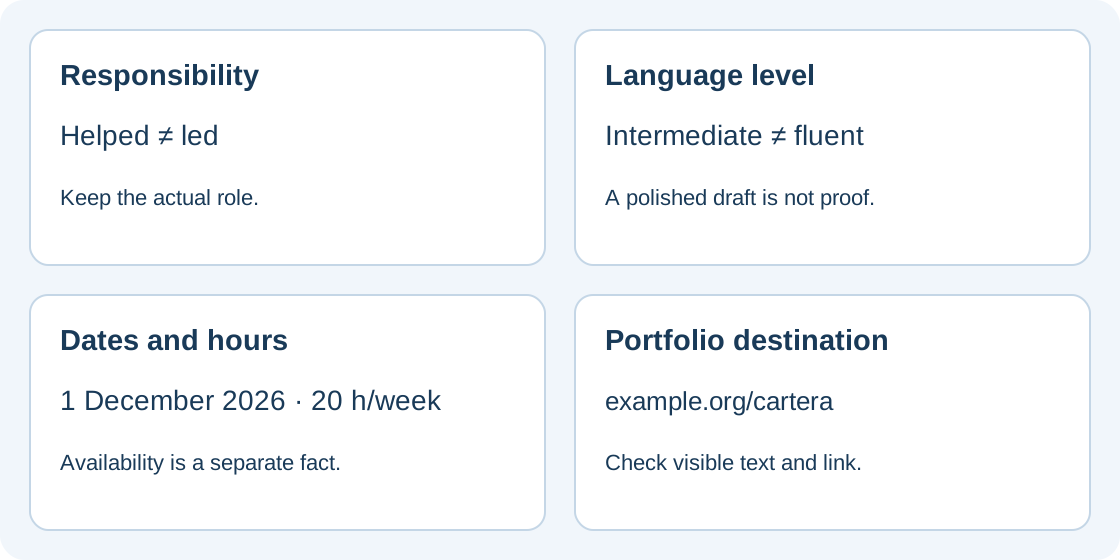
- Responsibility: “Ayudé” means the applicant helped. Retain “I did not lead the project”; do not promote the person to project lead.
- Quantity: “hasta 12” means up to 12 enquiries a day. It does not mean at least 12, an average of 12 or a proven improvement in response times.
- Language ability: keep intermediate English. A fluent translation is not evidence of the applicant’s fluency.
- Dates and hours: March 2024–October 2026 is the employment period. Availability starts on 1 December 2026 at 20 hours per week; it is not full-time or immediate availability.
- Identity and destination: check Noa Vega, Arco Norte, Nube Ladera and https://example.org/cartera character by character. In a real transferred document, inspect the visible address and the underlying link, including any query or fragment.
If the source itself is ambiguous or inconsistent with your CV, resolve it before using the translation. Do not guess a qualification’s equivalence, convert a job title into a more senior role or add work permission, salary expectations or a credential. A receiving organization may have separate requirements for official evidence; a text draft is not that evidence.
Make Deliberate Recipient-Specific Edits
The returned salutation says “Dear Mrs. Sol.” The Spanish “Sra.” does not establish the recipient’s preferred English title. Check the actual name and preferred title instead of inferring marital status. For the fictional named-recipient UK brief, “Yours sincerely” and a date written as “1 December 2026” are possible editorial choices; they were not the recorded automatic output.
A deliberate polish could also use UK “enquiries” rather than the returned “inquiries.” These are separate edits to convention and presentation. Keep the factual claims and the applicant’s voice intact, and have the applicant approve the final letter. Do not add enthusiasm for a product, a team relationship or a company achievement unless the applicant can honestly support it.
A cover letter uses personal statements about the applicant’s experience. Do not copy a blanket rule against “I” from CV formatting advice into a letter. Keep paragraphs purposeful and follow the vacancy’s instructions about length, attachments and contact details. Translation cannot decide whether an employer requires a letter or another application format.
For Longer Letters, Preserve the Relevant Context
Each normal text translation request is separate; do not assume the next section remembers the prior one. Keep each passage coherent and include the minimal permitted context needed to interpret a role, pronoun or project. Mark context repeated for translation so it is not duplicated in the final letter. Keep a separate reference list of approved employer names and role terms; it is not a protected glossary feature.
Compare the complete assembled letter with the source and CV after joining sections. A sentence that is correct alone can still contradict another paragraph. Back-translation can highlight a question, but it is not proof that responsibilities, qualifications or tone survived. A bilingual reader should check the complete source and final translation.
Use the Text Translation tool for a short permitted passage.
Choose the Right Input for an Image or Complete File
For a permitted screenshot, open the separate Image Translation tool. Select the target language, upload a clear PNG, JPEG, WEBP or static GIF within the displayed 4MB limit, then click Translate image. The source language is detected automatically and this workflow has a separate allowance. Keep complete lines visible, redact unnecessary details in the exported image and compare recognized names, dates, quantities and punctuation with the original.
Open Image Translation for a clear permitted screenshot.
For a complete supported file, use the separate Document Translation workflow and check its current accepted formats, file limit and allowance before uploading. This text example does not test a returned file or promise preserved layout, working hyperlinks or acceptance by an employer. Inspect any returned document and the final attachment or application form independently.
Open the separate complete-file translation workflow.
Check the Version You Will Actually Send
- Compare every factual statement with the current source, CV and any supporting records.
- Confirm the recipient, vacancy reference, preferred title, final language and contact details.
- Inspect the copied text or exported file for missing paragraphs, broken characters, incorrect dates and wrong visible or underlying links.
- Have the applicant approve the final wording. Recheck affected statements and renew that approval after a source or translation change.
- Keep identifiable final versions, follow the employer’s separate submission process and use qualified review where an official or sensitive requirement calls for it.
If you also need to understand the vacancy or translate a CV, use the related guides as separate tasks. Keep the role requirements, the applicant’s actual history and the letter consistent; translating one does not verify the other.
Read the job-description translation guide.
Read the resume translation guide.
Cover Letter Translation FAQ
How do I translate a cover letter into English?
Start with a permitted source letter and the employer’s actual language and format requirements. Select the source language and English in Text Translation, paste a coherent short passage and compare the returned draft with the source. Check responsibilities, qualifications, names, dates, hours and links before recipient-specific edits and the applicant’s final approval.
Can translation make my experience sound more senior?
It should express the same experience naturally without upgrading it. Helping with a project is not leading it, and a support assistant should not become a manager. Resolve unclear source wording with the applicant and keep factual changes separate from translation.
Should I translate a cover letter word for word?
Preserve its facts, intent and voice while using natural target-language wording. Greetings, closings, spelling and date presentation can need deliberate adjustments for the recipient. Check preferred titles and the employer’s instructions; do not add qualifications, motivations or company claims that the applicant cannot support.
Can I paste a screenshot of my cover letter?
Use the separate Image Translation tool for a permitted clear image. Choose the target, upload PNG, JPEG, WEBP or static GIF within the displayed 4MB limit, then click Translate image. Source detection is automatic and the allowance is separate. Compare recognized text with the original and redact unnecessary personal information in the exported image.
Does this preserve my Word or PDF layout?
The embedded demo translates short text; it does not preserve a complete document layout. For a supported whole file, check the separate Document Translation workflow’s current formats, size limit and allowance. Inspect the returned file, paragraph order, characters and visible and underlying links before using it.
Is the translated letter ready to submit?
It still needs a complete bilingual comparison and the applicant’s approval, with recipient details and the final transferred version checked. Keep the reviewed versions identifiable and recheck changes before sending through the employer’s own process. Translation does not certify credentials, verify eligibility, submit an application or guarantee an interview.